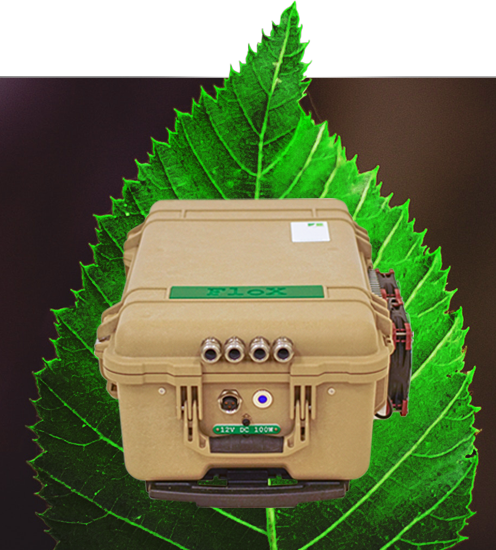
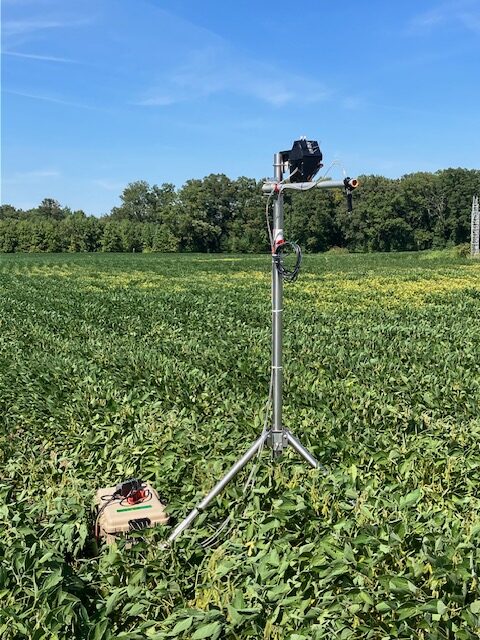
How a Hyperspectral Sensor Works
A modern hyperspectral sensor combines optical measurement with spatially resolved imaging. Instead of recording only red, green, and blue information, it measures a large number of narrow spectral bands across the visible and near infrared range. As a result, every pixel contains its own spectral signature. This makes a hyperspectral sensor especially valuable whenever subtle differences between materials, coatings, minerals, vegetation, or process conditions need to be detected reliably.
The principle behind this technology is straightforward. Different materials absorb, reflect, or emit electromagnetic radiation in different ways. A hyperspectral sensor records these differences with high spectral detail and converts them into structured image data. In many applications, this results in a hyperspectral data cube with two spatial dimensions and one spectral dimension. That additional layer of information allows users not only to see an object, but also to analyze what it is made of and how it changes over time.
This extended spectral view creates a clear advantage over standard cameras and many multispectral systems. While broader bands can highlight general trends, a hyperspectral sensor can detect much finer spectral variations. That is why the technology is widely used when quality, specificity, and analytical depth matter. It supports precise classification, comparison, and monitoring workflows across a wide range of scientific and industrial tasks.
Why a Hyperspectral Sensor Matters in Real Applications
A hyperspectral sensor is particularly useful when conventional imaging reaches its limits. In environmental monitoring, it can help assess vegetation condition, surface changes, moisture-related effects, or other spectral indicators that are relevant for long-term observation. In material analysis, it supports the differentiation of substances whose visual appearance may look almost identical to the human eye. In industrial environments, hyperspectral measurement systems can also be integrated into automated workflows for fast and repeatable inspection.
This makes the technology attractive for both laboratory and field use. On the one hand, a hyperspectral sensor delivers detailed spectral information for demanding research and development tasks. On the other hand, it can also support process-oriented applications where speed, reproducibility, and intelligent data evaluation are essential. With the right optics, illumination, and software pipeline, spectral data can be captured, processed, and interpreted in a highly efficient way.
Another important advantage is flexibility. A single hyperspectral sensor can support different analytical objectives because the recorded spectral information can be evaluated for multiple parameters at once. Instead of designing a system around only one index or one visual feature, users gain a broader data basis for classification, segmentation, and trend analysis. This is especially relevant in applications where materials, surfaces, or environmental conditions vary over time and need to be assessed with a high level of confidence.
JB Hyperspectral Solutions
JB Hyperspectral develops advanced sensing solutions for users who need products that can offer more than conventional imaging. Whether the goal is environmental observation, scientific measurement, or application-specific material analysis, a hyperspectral sensor from JB Hyperspectral helps transform spectral information into actionable insights.