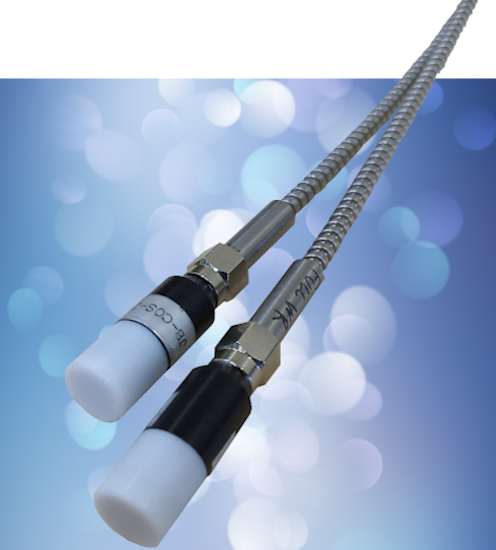
Example of cosine receptors installed on a Dust and Bird protection system connected to the FloX

Atmospheric Sensor

An atmospheric sensor is used to measure parameters of the atmosphere that directly influence environmental processes, measurement accuracy, and system performance. In field and research applications, atmospheric conditions such as pressure, temperature, humidity, and radiative influences play a critical role. Atmospheric sensors provide reliable data that helps interpret measurements correctly and supports informed decision making.

Unlike laboratory instruments, atmospheric sensors are designed for operation under real-world conditions. They must deliver stable results even when environmental influences change continuously. This makes them an essential component in environmental monitoring, research projects, and outdoor measurement systems.

DESCRIPTION

What matters outdoors

What makes atmospheric sensors compelling outdoors is their ability to translate complex, dynamic boundary-layer conditions into stable, comparable signals. Instead of isolated point measurements, they capture the coupled behavior of temperature, pressure, humidity, airflow, and radiative forcing as a coherent system. This is what enables meaningful interpretation beyond snapshots.

They resolve subtle gradients, diurnal cycles, and transient events that disappear in averaged or laboratory data. High temporal resolution combined with long-term stability allows users to separate natural variability from structural change. Atmospheric sensors do not compete with primary instruments. They elevate them. By quantifying the surrounding state of the atmosphere, they turn raw measurements into interpretable datasets. This is especially powerful in long time series and multi-site campaigns, where comparability is everything.

All of these are the focus of JB Hyperspectral’s RoX and  NoX which are built for permanent outdoor installation with features such as rugged waterproof cases, a 12 V battery or solar supply, and autonomous operation with long duration SD logging.

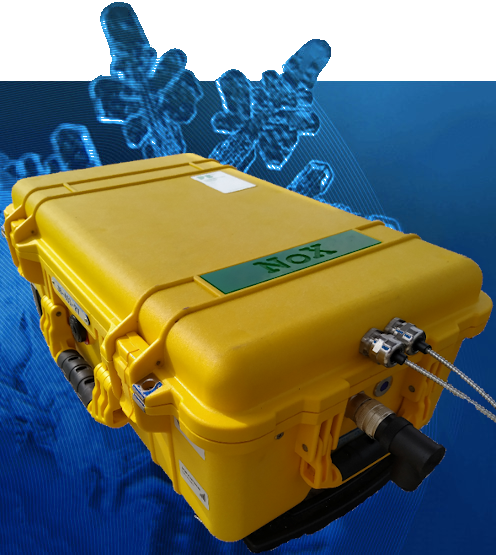
NOX

NIR reflectance BoX

Measuring Visible and Near Infrared radiance and reflectance, extending the RoX capabilities towards the NIR

FIND OUT MORE

ROX

Reflectance Box

Measuring reflectance effortless, the RoX is the all in one solution for your spectral survey.

FIND OUT MORE

JB COS

JB COS

Measuring solar irradiance from equator to poles. The cosine receptors for field spectroscopy applications.

FIND OUT MORE

Specifications

NoX (Near Infrared Reflectance Box)

Applications

Continuous reflectance monitoring that extends into the near infrared, including vegetation, snow, and harsh climate sites.

Advantages

Visible to near infrared coverage up to 1650 nm, dual field of view radiance and irradiance concept, rugged low power design for permanent outdoor installation.

Spectral range

~350–1100 nm (Spec 1) and ~900–1650 nm (Spec 2).

Dual FOV geometry

Upwelling radiance 25° and downwelling radiance 180°

Built for unattended monitoring

automatic signal optimization, accurate dark current determination each cycle, fully autonomous acquisition, quick measurements

RoX (Reflectance Box)

Application

Long term reflectance time series for environmental monitoring, including vegetation, water quality, and snow and ice studies.

Advantages

Fully autonomous weatherproof operation with low power consumption, dual channel irradiance and radiance workflow, stability checks and metadata for consistent time series.

Spectral range

VIS-NIR ~400–950 nm (other options available on demand).

Spectral performance

SSI ~0.65 nm and FWHM ~1.5 nm (SNR ~250).

Fast & autonomous in the field

Fully autonomous acquisition, quick measurements, large SD storage.

FAQ

What are Atmospheric Sensors?

Atmospheric sensors are instruments designed to capture the state and dynamics of the atmosphere with sufficient resolution and stability to make field data interpretable. Rather than measuring isolated variables in abstraction, they quantify how pressure, temperature, humidity, airflow, and radiative conditions interact in real environments. This makes them essential wherever atmospheric coupling matters.

How do atmospheric sensors differ from standard meteorological instruments?

While meteorological instruments focus on reporting weather parameters, atmospheric sensors are optimized for measurement stability, temporal resolution, and integration into scientific workflows. Their purpose is not forecasting, but explaining variability in field data and supporting quantitative analysis across time and space.

What makes atmospheric sensor data valuable for time series analysis?

Atmospheric sensors resolve diurnal cycles, short-term fluctuations, and gradual trends with sufficient continuity to distinguish natural variability from structural change. This enables robust trend analysis and allows subtle effects to be separated from environmental noise in long-term datasets.

Can JB provide assistance for instrument installation?

Yes. Just get in touch with us to request our installation service.

microscopy background image

Contact us for more info about our products

Contact us